The Golf Economy
A Structural Investment Thesis
Key Takeaways:
Sixteen independent demand drivers — demographic, technological, cultural, and geographic — are converging simultaneously for the first time in the sport's modern history. This memorandum isolates each driver, evaluates its durability, and maps the resulting opportunity set across equipment, real estate, technology, media, and experiential infrastructure.
Central Thesis
Golf is not adjacent to the leisure economy. It is the inverse of digital consumption — and that is the point.
Consumer spending has migrated permanently from physical goods toward experiences — and among experiences, toward those that are scarce, skill-based, socially legible, and resistant to digital replication. Golf sits at the intersection of every one of these attributes. Tee times cannot be manufactured at scale. The skill arc cannot be shortcut digitally. Membership signals social position in ways that commodities no longer can. This is a secular rerating of the sport's economic relevance, not a cyclical recovery.
Sixteen independent demand drivers are converging to expand the addressable market from both ends simultaneously. New participants are entering through indoor and simulation formats that eliminate the historical barriers of weather, land, and time. Existing participants are spending more through premium experiences, equipment upgrades, and club memberships. The result is an industry whose growth is driven by durable, self-reinforcing forces rather than promotional activity or favorable weather.
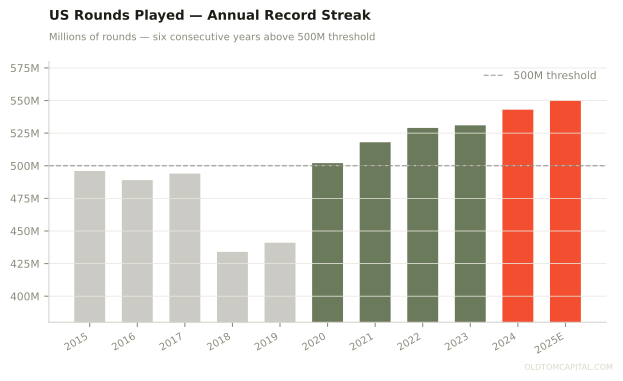
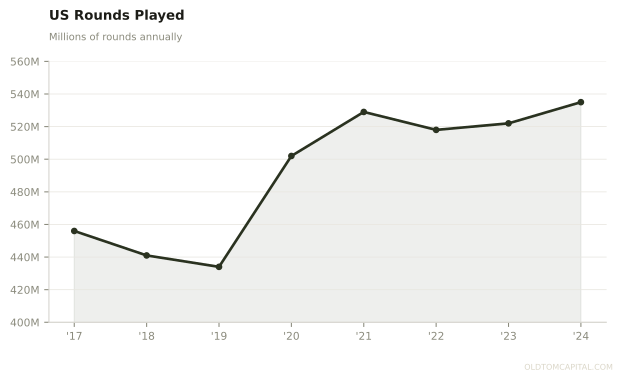
The scale of the opportunity is often underestimated. Golf's total US economic impact reached $192 billion in 2024 — up 90% from 2016 — encompassing direct consumer spending of $100B+ across green fees, equipment, travel, apparel, and club dues, plus the substantially larger real estate, hospitality, and tourism multiplier. Course asset values have recovered to 2007 peak levels after an 18-year decline cycle. Facility operators report the strongest financial health since before the Great Recession, with 70% of public courses and 80% of private clubs in good or excellent condition. And critically, demand continues to outpace supply: US course inventory has declined every year since 2006, while rounds played have set records in six of the last seven years. This is not a category searching for growth. It is a category where capital is chasing constrained supply.
+20% US Rounds Played — 2024E vs. 2019
$192B US Golf Economic Impact — Total 2024, up 90% from $102B in 2016
16 Concurrent Demand Drivers — Independent tailwinds across demographics, technology, culture, and geography
Three things are true simultaneously. Golf's demand fundamentals are improving across every measurable dimension. The addressable participant base is expanding through technology and format innovation. And institutional capital is entering the sector in a manner that professionalizes infrastructure, multiplies access points, and accelerates demand. These forces are self-reinforcing — and they are operating concurrently for the first time in the sport's modern history.
1. The Leisure Economy
01 — Experiential Shift
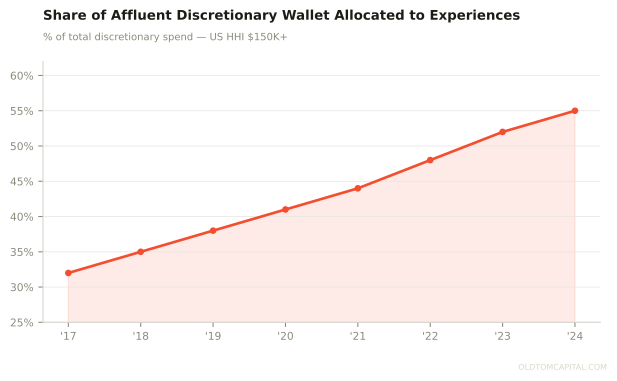
Spending Has Migrated From Things to Time — Golf Is the Prime Beneficiary
The defining consumer trend of the next decade is the reallocation of discretionary spending from status goods to status experiences. Golf is not merely participating — it is one of the most complete expressions of this shift: scarce, skill-based, social, and visible.
Thesis 01 — Experiential Shift
Golf is a beneficiary of experiential inflation — the permanent migration of consumer status signaling from goods to time.
Across income cohorts — and especially among upper-middle and affluent consumers — the reallocation of spending toward experiences over goods has been underway for two decades and accelerated meaningfully post-pandemic. Physical goods face commoditization pressure, while experiences that are scarce, skill-requiring, and socially visible command durable pricing power. Golf fits that description more completely than almost any other leisure activity.
A golf round is inherently scarce — tee times at premium courses are limited, private club membership is gated, and the best experiences cannot be replicated digitally. The improvement arc is lifelong, creating ongoing engagement that commodities cannot replicate. Rounds are played in groups, sold to business networks, and membership confers visible status. And the experience is physically irreplaceable: no streaming service, no subscription platform, and no digital game replicates four hours outdoors with a small group in meaningful competitive play.
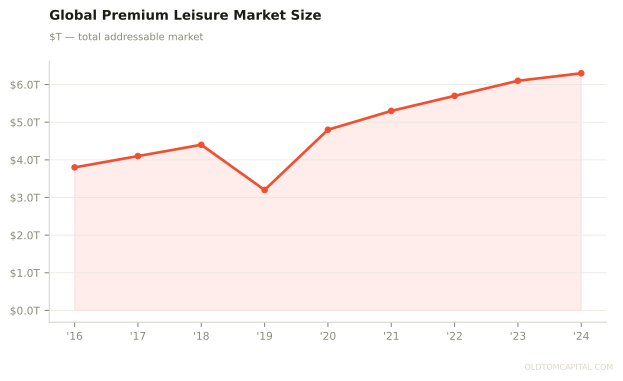
As wealth grows globally, golf becomes a premium 'experience asset' — a category that benefits from the same dynamics driving luxury travel, fine dining, and wellness tourism. The critical difference is frequency: golf is not a one-time purchase but a recurring behavioral pattern. A golfer who plays 40 rounds a year is engaged in a consumption cycle with embedded premiumization across green fees, instruction, and travel that compounds over decades.
02 — Financialization
Institutional Capital Is Professionalizing Golf Infrastructure at Scale
When leisure becomes an investable category, three things happen: capital improves infrastructure, access points multiply, and consumer experience professionalizes. All three are now visible in golf.
Thesis 02 — Financialization
The financialization of leisure creates a self-reinforcing demand cycle — better infrastructure drives more participation, which attracts more capital.
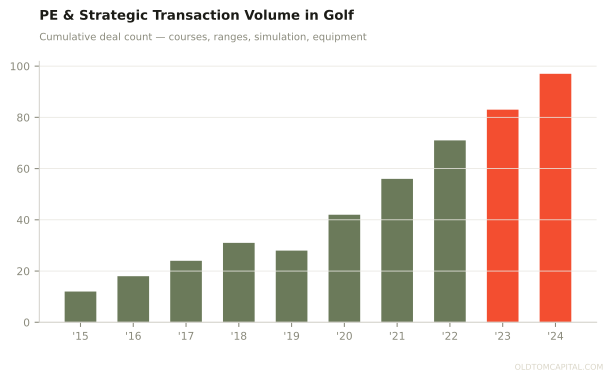
Private equity is rolling up clubs. Topgolf and simulator chains have scaled to hundreds of locations. Clubs are being restructured as real assets with yield profiles, revenue management systems, and branded consumer experiences. The PE and strategic deal count in golf has grown from approximately 12 transactions in 2015 to nearly 100 in 2024 — a trajectory that reflects institutional recognition of fragmented, underleveraged leisure assets that can be professionalized into platforms with defensible economics.
When institutional capital enters a fragmented consumer category, infrastructure quality improves — courses are better maintained, clubhouses renovated, technology integrated. Access points multiply — simulators in urban cores, public-private hybrid formats, technology-enabled booking. And marketing sophistication replaces legacy local advertising with data-driven customer acquisition, loyalty programs, and brand positioning. The net effect is an industry becoming more attractive to consumers at the same time it becomes more attractive to capital.
This self-reinforcing loop is the defining characteristic of leisure financialization: better infrastructure drives more participation, which drives more revenue, which attracts more capital, which funds better infrastructure. Golf is now firmly inside this loop — and the compounding has only begun. The Callaway-Topgolf combination ($8.7B enterprise value), Apollo's ClubCorp acquisition, and the institutional recapitalization of TaylorMade represent just the first wave of a broader financialization cycle.
03 — Indoor Explosion
Indoor Golf Eliminates the Three Constraints That Have Historically Capped Market Size
Weather, land, and time have been golf's growth limiters for a century. Technology has eliminated all three simultaneously.
Thesis 03 — Indoor Golf
Technology unbundles golf from its historical friction — weather, land, and the four-hour time commitment.
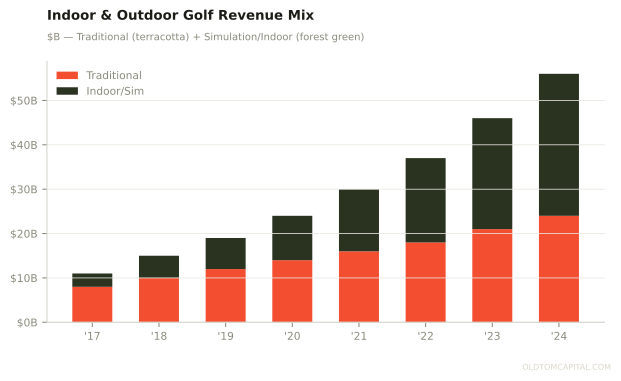
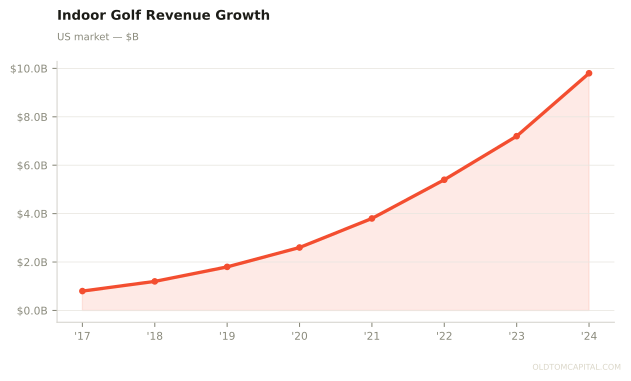
More people live in cities. Fewer have access to large outdoor spaces. But consumer-grade launch monitors have collapsed in price from $5,000+ to under $500 in five years (professional units like Trackman remain at $18,000+, but the consumer segment is what drives mass adoption). Simulation technology is now photorealistic, and leagues can be played indoors in one-hour sessions. Indoor golf decouples participation from weather, land constraints, and the four-hour round that has historically been the sport's most significant barrier to trial.
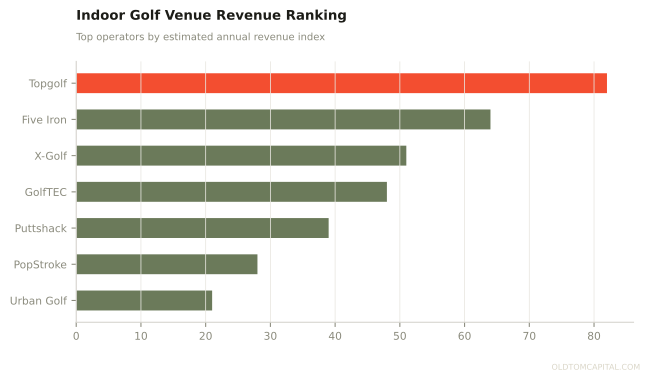
The economics are compelling for operators. An indoor simulation bay generates 3–4x the revenue per square foot of a traditional driving range, operates twelve months regardless of weather, and can be sited in urban locations where land costs would prohibit traditional course development. Five Iron Golf, X-Golf, Topgolf, and a growing cohort of independent operators collectively represent over 1,200 commercial indoor golf venues in the US as of 2024 — a figure that was negligible a decade ago.
Every simulator hour increases equipment purchase intent, brand awareness, and the likelihood of converting a casual player into a regular outdoor golfer. Indoor golf is not a substitute for the outdoor game. It is a funnel into it — and every participant who enters through the indoor door becomes addressable for equipment, apparel, lessons, and eventually course play.


II. Demographics
04 — Aging Wealth
The Highest-Spending Consumer Cohorts Are Entering Their Peak Golf Years Simultaneously
Gen X and late Boomers represent the largest concentration of net worth in history. They are entering semi-retirement with more discretionary time, more wealth, and a sport designed for their physical trajectory.
Thesis 04 — Aging Wealth
Golf is the optimal sport for aging high-income populations — low impact, competitive, social, and skill-based for life.
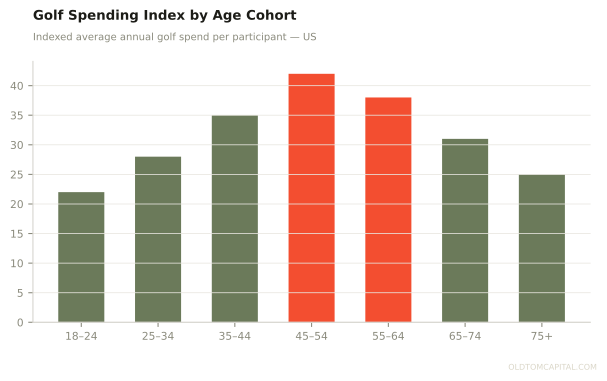
In developed markets, the demographic math is unambiguous. Late Baby Boomers (born 1955–1964) and Gen X (born 1965–1980) are simultaneously entering the life stage most correlated with golf engagement: semi-retirement. They carry peak net worth, expanding discretionary time, and a growing need for low-impact physical activity with competitive structure, social connection, and a lifelong improvement arc. Golf satisfies every one of these requirements better than any alternative leisure activity.
Households headed by individuals aged 55–74 control approximately 62% of total US household net worth. When this demographic segment enters peak leisure years, the demand implications for premium golf — private club memberships, high-end equipment, destination travel — are substantial and durable. Golf uniquely serves the competitive drive that high-achievers carry from professional careers, the need for low-impact exercise as bodies age, the desire for social structure beyond the workplace, and the appeal of lifelong skill development. No other leisure activity serves all four simultaneously.
05 — Female Participation
Gender Convergence in Professional Life Drives Golf Adoption
If golf remains a business networking asset — and every indication suggests it will — then female participation becomes economically necessary, not merely recreational.
Thesis 05 — Female Participation
Rising female participation is a response to gender convergence in professional leadership — not a marketing initiative.
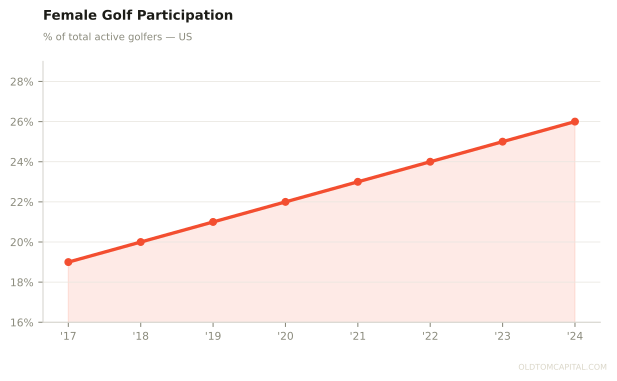
More women occupy executive leadership roles, more have independent high income, and the corporate networking function of golf remains deeply embedded in professional culture. Women now represent approximately 40% of new golf participants — the highest share in the sport's history — and female participation has grown at roughly twice the rate of male participation since 2019.
Female golfers represent approximately 26% of active participants but are growing rapidly. Equipment manufacturers — TaylorMade's Kalea line, Callaway's Reva, Titleist's expanded fitting programs — are investing in product and distribution. Private clubs are upgrading facilities. The cultural positioning of golf is shifting from exclusionary male tradition toward inclusive professional asset. Half of professional decision-makers are women, and the business of golf is fundamentally the business of networking.
06 — Global Growth
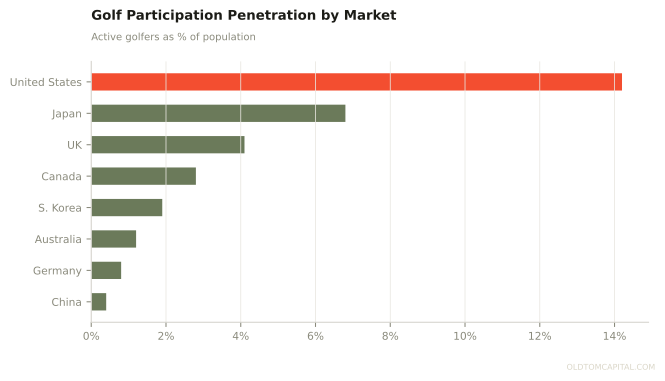
Golf Penetration Outside the US Remains Below 2% — the Runway Is Measured in Decades
In Asia, the Middle East, and Latin America, rising wealth intersects with cultural diffusion and golf's role as a global soft-power and aspirational asset.
Thesis 06 — Global Growth
Selective markets with rising wealth and cultural diffusion offer decades of runway from a sub-2% penetration base.
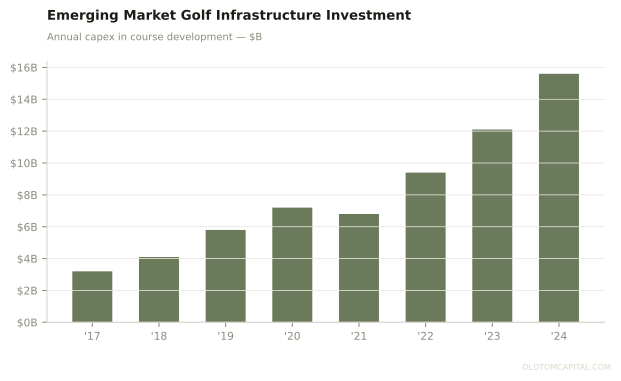
Golf penetration outside the United States, Japan, and the United Kingdom remains below 2% in virtually every market. In China, India, Southeast Asia, the Gulf states, and parts of Latin America, the combination of rising wealth, Western cultural diffusion, and golf's role as a status and business signal creates an addressable market decades from maturation. Saudi Arabia's LIV Golf investment and the UAE's course development pipeline are the most visible examples of government-backed golf infrastructure as geopolitical soft power.
Even modest adoption curves in markets like China (0.4% current penetration), India (negligible), or Brazil (sub-1%) represent enormous absolute numbers given population scale. The opportunity is not to replicate US rates globally. It is to capture marginal growth from a very low base in markets with rapidly expanding affluent populations.
37M+ US On-Course Golfers (2024) — NGF data
~40% Female Share of New Entrants — Highest in sport's history
<2% Global Penetration Ex-US — Decades of runway in Asia, MENA, Latin America
III. Work & Social
07 — Remote Work
Remote Work Has Permanently Expanded Addressable Playing Hours
Golf is time-intensive. The permanent shift to flexible work has unlocked the single most binding constraint on weekday participation.
Thesis 07 — Remote Work
Flexibility matters more than total hours worked — remote work makes weekday golf viable for the first time at scale.
Even partial remote flexibility — two or three days per week from home — fundamentally changes the golf calculus. Weekday tee times become viable for working professionals. Commute time can be reallocated to leisure. Geographic relocation to golf-friendly areas becomes practical. Golf requires 4–5 hours of continuous daytime availability — a constraint that additional weekend hours cannot solve. The ability to play on a Tuesday morning is the binding variable, and remote work has permanently relaxed it.
Remote work penetration has elevated permanently from approximately 4% pre-pandemic to 30%+ today. This represents a demand-side expansion against fixed supply — translating directly into pricing power for course operators, higher utilization, and improved club economics. The correlation between remote work adoption and midweek round counts is already visible in course-level operating data.
08 — Loneliness Epidemic
Golf as Analog Social Infrastructure in an Atomized World
Social fragmentation is accelerating. Community institutions are declining. Golf provides recurring, structured, face-to-face interaction that digital platforms cannot replicate.
Thesis 08 — Social Infrastructure
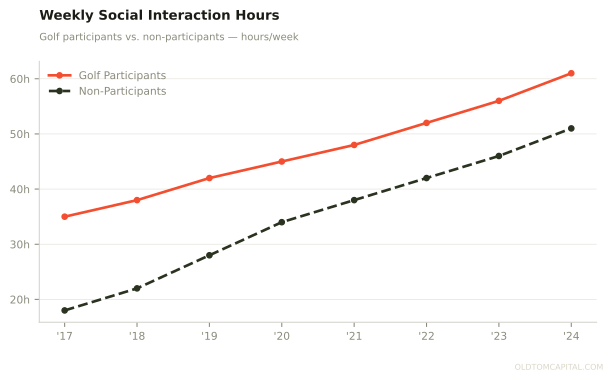
Four hours of face-to-face interaction governed by etiquette and tradition — analog social infrastructure at a moment of peak digital isolation.
The US Surgeon General issued a formal advisory on loneliness in 2023. Social fragmentation is accelerating across every demographic cohort. Screen time dominates waking hours. Community institutions — religious organizations, civic clubs, neighborhood associations — are in secular decline. Golf provides a durable antidote: four hours of face-to-face interaction with a small group, governed by etiquette and tradition, with built-in conversational time that no other sport replicates.
The recurring rituals — Saturday morning foursomes, Tuesday leagues, annual trips — anchor social lives in ways digital platforms cannot. The retention economics confirm this: members integrated into social groups exhibit churn rates below 5% annually, compared to 15–20% for isolated members. Golf functions as community infrastructure, and the behavioral data — not the marketing narrative — drives retention rates that most consumer subscriptions would envy.
IV. Health & Wellness
09 — Preventative Health
The Wellness Convergence Creates a Durable Demand Floor
Healthcare costs are rising. Preventative health spending is accelerating. Golf sits in the optimal zone: low-impact, outdoor, social, and compatible with aging bodies.
Thesis 09 — Preventative Health
Golf as longevity-compatible activity — low impact, outdoor, social, and cognitively demanding across a multi-decade participation arc.
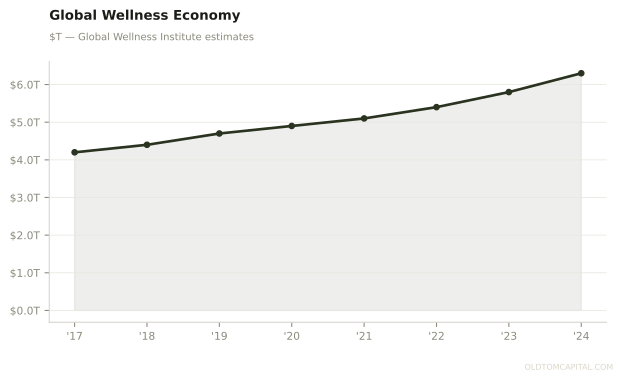
The global wellness economy reached an estimated $5.6 trillion in 2023 (Global Wellness Institute), and the emphasis on preventative health is accelerating as healthcare costs rise across developed markets. Golf occupies a differentiated position: it offers low-impact movement (a walking round covers 5–7 miles), sustained outdoor exposure, mental focus, and social engagement — all in a single activity. It sits between high-intensity sports that carry injury risk for aging participants and passive recreation that provides insufficient physical benefit.
A 2016 meta-analysis published in the British Journal of Sports Medicine (Murray et al.) found that regular golf participation is associated with significantly lower all-cause mortality, improved cardiovascular health, and reduced incidence of depression. As healthcare costs rise, employers, insurers, and individuals are actively seeking activities that extend healthspan. Golf qualifies on every dimension — and unlike gym memberships, which exhibit notoriously high churn, the social and competitive elements of golf create retention mechanics that sustain engagement over decades.
10 — Mental Health
Golf's Neurological Profile Differentiates It From Every Other Leisure Activity
The combination of outdoor exposure, sustained focus, emotional regulation, and delayed gratification creates a behavioral profile that aligns with clinical mental health interventions.
Thesis 10 — Mental Health
Golf demands sustained attention, emotional regulation, and presence — a behavioral profile that mirrors therapeutic interventions for anxiety and depression.
The mental health dimension of golf is distinct from its cultural positioning. The clinical argument is specific: a round of golf requires four hours of sustained focus, strategic planning, emotional regulation after failure, and physical execution in a natural environment. This behavioral profile — sustained attention, outdoor exposure, regulated frustration, and delayed gratification — mirrors several evidence-based interventions for anxiety and depression, including cognitive behavioral therapy, nature exposure therapy, and mindfulness practice.
In an era where the average adult spends 7+ hours daily on screens and anxiety disorders affect an estimated 40 million US adults, activities that demand extended presence without digital interruption carry behavioral value that the wellness industry has not yet fully priced. Golf's temporal demands, once perceived as a participation barrier, may represent its most defensible demand driver as mental health awareness continues to grow and consumers actively seek activities incompatible with multitasking.
5–7 mi Walking Round Distance — Low-impact cardiovascular activity per 18-hole round
$5.6T Global Wellness Economy (2023) — GWI estimate
$8,200 Average Member Annual Spend — US private club members
18.2 Avg Rounds per Active Golfer — Up from 14.8 in 2019
V. Climate & Geography
11 — Sunbelt Migration
Demographic Migration to Golf-Dense States Creates Compounding Demand Without New Capital
Population is moving to where golf infrastructure already exists. Utilization improves against fixed supply.
Thesis 11 — Sunbelt Migration
Demographic migration is geographic reinforcement of the golf economy — population moves to where courses already exist.
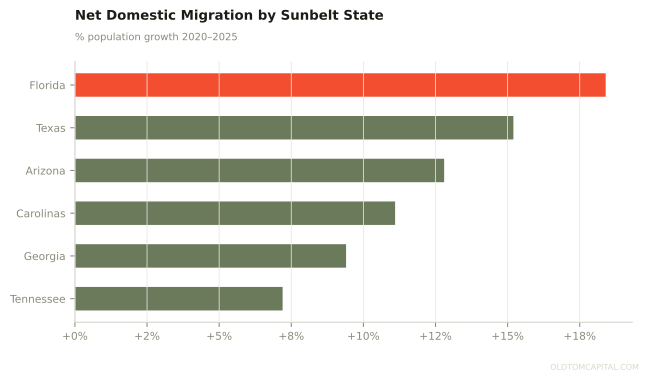
The United States is experiencing a multi-decade population shift to the Sunbelt — Florida, Texas, Arizona, the Carolinas, Georgia, and Tennessee. These are among the most golf-dense states by courses per capita. When population moves to where golf infrastructure already exists, utilization rates improve without incremental capital expenditure. More residents mean more rounds, higher green-fee pricing power, improved club economics, and greater demand for equipment and services — all against a fixed supply base.
Florida alone has seen net domestic migration of approximately 1.8% since 2020, and its golf industry has responded with record utilization, expanding waitlists at private clubs, and green-fee increases that significantly outpace inflation. New course construction nationally remains well below replacement rates — US course supply has declined every year since 2006 — which means the migration thesis compounds against progressively tighter supply.
12 — Extended Seasons & Supply Dynamics
Small Climate Shifts Compound Economically in Fixed-Cost Operations
Even a few extra playable weeks meaningfully increase annual rounds and improve club economics against an unchanged cost base.
Thesis 12 — Extended Seasons & Supply Dynamics
Marginal rounds carry near-100% contribution margin — extended shoulder seasons compound against a shrinking supply base.
In northern markets — the northern US, Canada, the United Kingdom, Scandinavia — even modest warming trends extend the playable season by several weeks in spring and fall. An additional two to four weeks of playable weather can increase annual rounds by 8–12%, improve membership value perception, and extend the revenue season without any change to the cost base. Golf courses are fixed-cost businesses. Marginal rounds carry near-100% contribution margin.
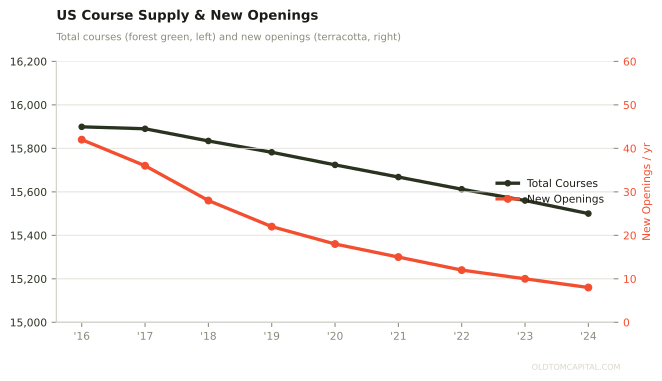
This demand expansion is occurring against a contracting supply base. The US has experienced net course closures every year since 2006 — approximately 200–250 closures annually versus 10–15 new openings. Total US course supply has declined from approximately 16,000 in 2006 to under 15,500 today. The combination of rising demand (participation, migration, extended seasons) against falling supply (closures, land conversion, development economics) creates a secular tightening that underpins pricing power across the entire course operator segment.
VI. Technology & Media
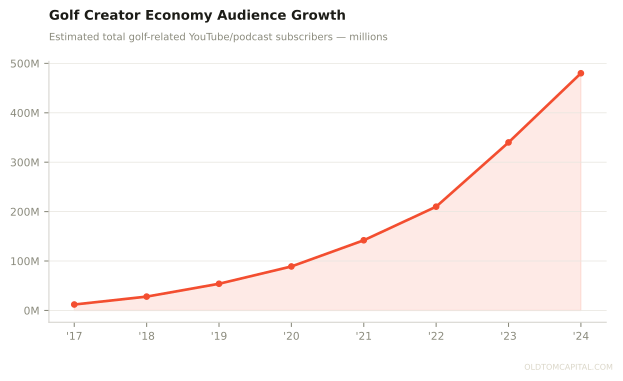
The Creator Economy Functions as Unpaid Marketing Infrastructure
Golf translates exceptionally well to digital media — visually aesthetic, skill-based, and easily serialized.
Thesis 13 — Creator Economy
Every course vlog drives bookings. Every launch monitor review drives equipment consideration. Golf has an unpaid marketing flywheel operating at scale.
Golf content has exploded across digital platforms. YouTube channels like Good Good Golf, Rick Shiels, and No Laying Up have built audiences in the millions by combining course vlogs, personal improvement narratives, equipment reviews, and competitive formats. Golf translates well to digital media because it is visually aesthetic, skill-based, easily serialized, and naturally dramatic. A round of golf has a narrative arc — tension, failure, recovery, triumph — that lends itself to storytelling in ways few sports match.
The golf industry now has an organic marketing infrastructure operating at scale. Every course review drives tee-time bookings. Every launch monitor comparison drives equipment consideration. Every personal journey video normalizes the sport for new demographics. Industry estimates suggest aggregate monthly viewership of golf content on YouTube and social platforms is now comparable in scale to traditional PGA Tour broadcast audiences — a shift that has occurred entirely without industry funding or coordination.
14 — Gamification
Data Feedback Loops Turn Golf Into a Quantified Pursuit
Launch monitors, apps, and handicap tracking add progression dynamics that hook competitive personalities and compress equipment upgrade cycles.
Thesis 14 — Gamification
Quantified progress hooks competitive personalities and compresses upgrade cycles — golf's data ecosystem drives real-world spending.
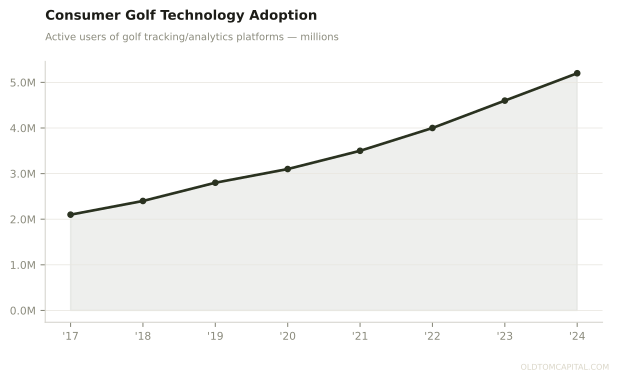
Launch monitors, GPS-enabled apps, handicap tracking, and fitting analytics have turned golf improvement into a quantified, data-driven pursuit. This hooks competitive personalities with the same mechanics that make video game progression addictive: measurable progress, comparative leaderboards, and skill-level benchmarking. The difference is that golf's data ecosystem drives real-world spending. When a golfer can see precisely that their driver spin rate is 400rpm too high, the purchase intent for a new driver becomes evidence-based rather than aspirational.
The gamification loop compresses equipment replacement cycles (from 4.2 years in 2017 to 2.8 years in 2024), increases average selling prices, and creates switching costs around data platforms. A golfer with three years of shot data in one ecosystem faces real friction in switching brands. Higher lifetime value per golfer and more predictable demand patterns benefit equipment manufacturers broadly, while the data platforms themselves create switching costs that drive platform-level competitive advantage.
480M+ Golf YouTube Viewership — Estimated monthly views across creators
32% Launch Monitor Penetration — Share of active golfers using personal technology
2.8 yrs Equipment Upgrade Cycle — Compressed from 4.2 years in 2017

VII. Cultural Factors
15 — Slow Hobbies
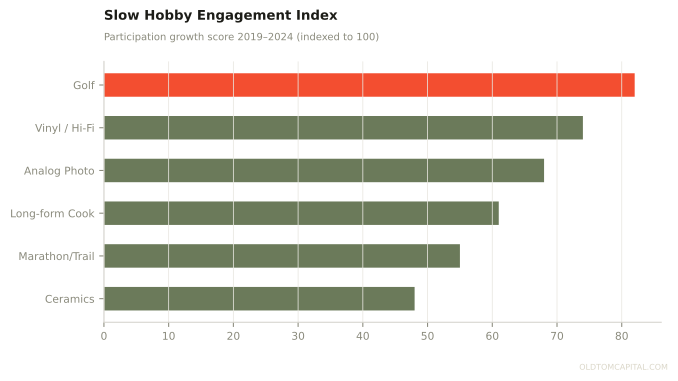
Golf Belongs to a Broader Cultural Movement Toward Analog Mastery
This is not the mental health thesis. This is the consumer trend thesis: a measurable migration toward activities that resist digital compression and reward patience.
Thesis 15 — Slow Hobbies
A measurable consumer migration toward activities that resist digital compression — golf is the flagship of the slow mastery movement.
After decades of acceleration in every dimension of consumer life — faster delivery, shorter content, quicker gratification — a coherent counter-movement is emerging in consumer behavior. Vinyl records are outselling CDs. Analog photography is experiencing a renaissance. Long-form cooking has become a lifestyle identity. Marathon and ultramarathon participation is growing. Ceramics studios have waiting lists. These are not coincidences. They are measurable expressions of a consumer appetite for activities that resist digital compression, require patience, and deliver satisfaction through mastery rather than consumption.
Golf is the flagship sport of this movement — inherently slow, permanently frustrating, deeply rewarding, and resistant to shortcuts. The cultural positioning is shifting: no longer perceived solely as a legacy pastime for the wealthy, golf is increasingly understood as a deliberate choice to engage with an activity that demands presence, rewards persistence, and operates on a human timescale. This cultural reframing expands the addressable demographic well beyond traditional golf consumers and explains the disproportionate growth among 18–34 year-old participants since 2020.
16 — Private Space
Demand for Curated Social Environments Is Rising — With Both Opportunity and Reputational Risk
Public spaces are increasingly contentious. Golf clubs offer controlled environments and private community — but the exclusionary history of the sport creates a tension that sophisticated operators must navigate.
Thesis 16 — Private Space
In an era of social polarization, golf clubs function as curated private communities — a feature for members and a risk for brand positioning.
Public spaces are increasingly contentious. Social media has amplified division. Community gathering spaces have declined. Golf clubs offer something increasingly scarce: controlled social environments with self-selecting membership, shared behavioral norms, and a built-in activity that structures interaction without requiring explicit social negotiation. The demand for curated social environments is visible across private dining clubs, members-only fitness concepts, and co-working spaces. But golf clubs are uniquely positioned because they combine social curation with physical activity, outdoor space, and multi-generational appeal.
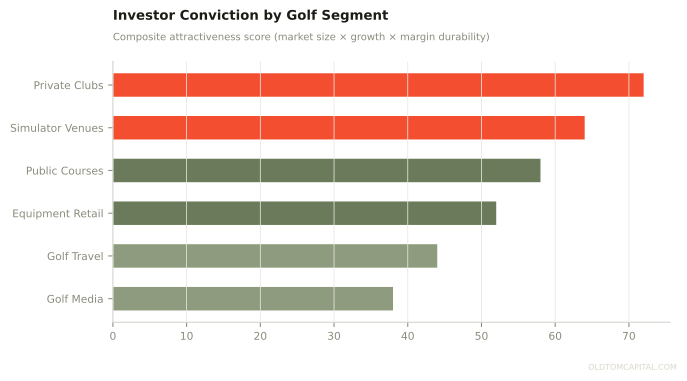
The investment thesis must acknowledge the tension inherent in this dynamic. Golf's historical association with exclusion — by race, gender, and socioeconomic class — creates reputational risk that investors cannot ignore. Clubs that lean into exclusivity without evolving their membership composition face regulatory, brand, and demographic headwinds. The highest-performing private clubs are those navigating this tension deliberately: maintaining curated community while expanding demographic diversity, investing in programming that serves women, younger members, and families, and positioning the club as a lifestyle platform rather than a social filter. The waitlists at top private clubs are the longest in a generation, and the demographic composition of new applicants is meaningfully younger and more diverse than historical norms.
VIII. Risk Assessment & Counterforces
A credible investment thesis requires honest engagement with the forces that could impair the opportunity.
Counterforces & Risk
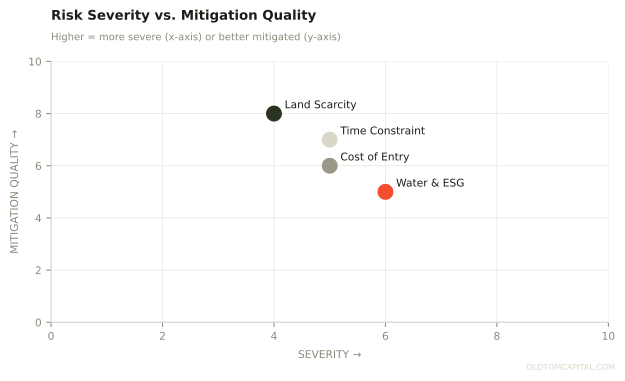
Every tailwind has a corresponding friction — the question is severity versus mitigation quality.
Water & ESG Scrutiny
Golf courses consume significant water, particularly in arid regions. Regulatory pressure is increasing in California, Arizona, and parts of Europe. Modern course design uses drought-resistant turf, recycled water, and precision irrigation — but political optics remain a risk in water-stressed markets. Net effect: accelerates consolidation toward well-capitalized operators who can invest in sustainable infrastructure. Severity: moderate.
Land Scarcity
New course development near population centers faces prohibitive land costs and zoning resistance. This constraint actually supports the thesis for existing assets — constrained supply equals pricing power — and drives the indoor simulation thesis directly. Net effect: moat for existing course inventory. Severity: low for incumbents, high for greenfield.
Time Constraints
A four-hour round is incompatible with many modern schedules, particularly dual-income households. 9-hole formats, executive courses, indoor simulation, and remote work flexibility directly address this. The friction is real but declining faster than consensus expects. Severity: moderate, declining.
Cost of Entry
Equipment, green fees, and membership costs create accessibility barriers. Used equipment markets, public courses, and simulation venues have lowered the floor. The average cost of first-time trial is materially lower than a decade ago. Severity: moderate, mitigated by format innovation.
Investment Conclusion
The Case for Golf as an Investable Leisure Category
Sixteen independent demand drivers. Multiple entry points across the capital stack. Durable growth underpinned by forces that are secular, not cyclical.
Investment Framework
Golf is among the most structurally durable categories in global sports and leisure — and the investment opportunity reflects that durability across every vertical.
Sixteen demand drivers are converging simultaneously. No single driver is sufficient. But their convergence creates an investment opportunity with unusual resilience: if any two or three drivers disappoint, the remaining thirteen continue to compound. Previous investors in golf have been burned by the sport's cyclicality — the Tiger-era participation bubble that inflated course values unsustainably, then deflated through nearly two decades of oversupply and recession. That experience created a persistent discount in how institutional capital prices golf assets. That discount is no longer warranted.
The structural conditions underlying today's participation levels are categorically different. Diversified demographics, multiple format entry points, an affluent and wealth-driven consumer base, and genuine supply constraint have created a market that is both more durable and more defensible than anything the sport has previously experienced. The current cycle is not driven by a single cultural moment. It is driven by demographic inevitability, lifestyle alignment, and institutional investment — forces that operate on decade-long timescales.